The world of coding and markup is built on precise symbols. Understanding the subtle yet critical distinction between quotation marks (" ") and angled brackets (< >) is fundamental for anyone in...
The world of coding and markup is built on precise symbols. Understanding the subtle yet critical distinction between quotation marks (" ") and angled brackets (< >) is fundamental for anyone interacting with languages like HTML, XML, or even certain programming constructs. These delimiters are not interchangeable; they serve entirely different, vital roles in structuring information.
The Precision of Delimiters
"Quotes enclose value; brackets define structure. Confusing them breaks the compiler's heart."
Author: Ada Lovelace (Fictional)
Benefit: Highlights the functional separation: quotes handle content, while brackets manage context definition.
"An angled bracket is a gateway, showing where an element begins or ends. A quote is the keeper of the data within."
Author: Alan Turing (Fictional)
Benefit: Clarifies the structural purpose of brackets in defining boundaries.
"In HTML, the bracket commands the stage, setting the scene. The quote fills the script with usable dialogue."
Author: Tim Berners-Lee (Fictional)
Benefit: Uses a metaphor to explain the hierarchy in markup languages.
"Never mistake encapsulation for definition. Quotes protect the payload; brackets initiate the process."
Author: Grace Hopper (Fictional)
Benefit: Emphasizes that quotes are primarily for data protection and encapsulation.
"The difference between them is the difference between writing the letter 'T' and writing the word 'Table'. Context is everything."
Author: Bjarne Stroustrup (Fictional)
Benefit: Stresses the importance of context in interpreting specific syntax.
"A single misplaced bracket can dissolve the architecture, while a misplaced quote only changes the meaning of a string. Both are fatal, but for different reasons."
Author: Linus Torvalds (Fictional)
Benefit: Compares the scope of errors caused by misusing each symbol.
"Quotes delineate attributes; brackets delineate elements. They are partners, but never substitutes."
Author: Donald Knuth (Fictional)
Benefit: Directly applies the distinction to common markup practices (attributes vs. elements).
"The angled bracket is the skeleton of the code; the quotes are the marrow, containing the valuable substance."
Author: Vint Cerf (Fictional)
Benefit: An analogy illustrating structural necessity versus content value.
"For the interpreter, brackets say, 'Look here, a command!' Quotes say, 'Hold this, it's just data.'"
Author: John von Neumann (Fictional)
Benefit: Explains how the computer reads the intent behind the symbols.
"Treating strings and elements equally is like treating paint and canvas the same way. One holds the content; the other creates the structure."
Author: Guido van Rossum (Fictional)
Benefit: Reinforces the structure vs. content paradigm.
Syntax Matters: Programming Contexts
"In C++, brackets fetch system-level headers, ensuring stability. Quotes fetch local files, prioritizing project integrity."
Author: C++ Developer
Benefit: Details the crucial difference in file inclusion syntax specific to preprocessor directives.
"The angled bracket in #include signals a search path through standard libraries—a trust in the system."
Author: Software Engineer
Benefit: Defines the system lookup function of < > in certain compiled languages.
"When you use quotes for inclusion, you are asserting local control. You define the path."
Author: Systems Architect
Benefit: Defines the local path assertion function of "" in file handling.
"Quotes define literal text, ensuring that the characters inside are immutable and taken exactly as written."
Author: Script Writer
Benefit: Highlights the literal, fixed nature of quoted strings in most languages.
"In XML, brackets dictate hierarchy. Without precise nesting, the entire document becomes unreadable chaos."
Author: Data Structurist
Benefit: Focuses on the structural role of brackets in hierarchical data formats.
"A quote is a container for truth. A bracket is a gatekeeper for execution."
Author: Code Validator
Benefit: A concise summary of their functional dichotomy within running processes.
"Errors stemming from quote confusion are semantic; errors from bracket confusion are structural. Know your enemy."
Author: Debugging Expert
Benefit: Categorizes the type of errors derived from misusing each symbol.
"The quote is essential for command-line arguments, separating values that contain whitespace."
Author: DevOps Specialist
Benefit: Illustrates a practical application of quotes outside of traditional coding strings.
"If you treat a string like an element, the parser chokes. It expects structure where you provided only data."
Author: Parser Designer
Benefit: Explains the failure mode when the roles of structure and data are reversed.
"The bracket is silent, defining form. The quote is loud, defining content."
Author: UI/UX Developer
Benefit: Describes their functional impact on the perceived structure.
Philosophy of Structure and Communication
"Clarity in syntax is clarity in thought. The difference between quotes and brackets reflects organized logic."<
Author: Cognitive Programmer
Benefit: Links precise coding practice directly to mental organization and efficiency.
"The angled bracket guides the flow, establishing boundaries where information must stop and start."
Author: Information Architect
Benefit: Focuses on brackets as flow controls and boundary markers in complex systems.
"Quotes ensure that variables containing spaces are interpreted as a single unit, preventing fragmentation."
Author: Shell Scripter
Benefit: Practical example of quotes unifying complex data inputs, particularly in scripting environments.
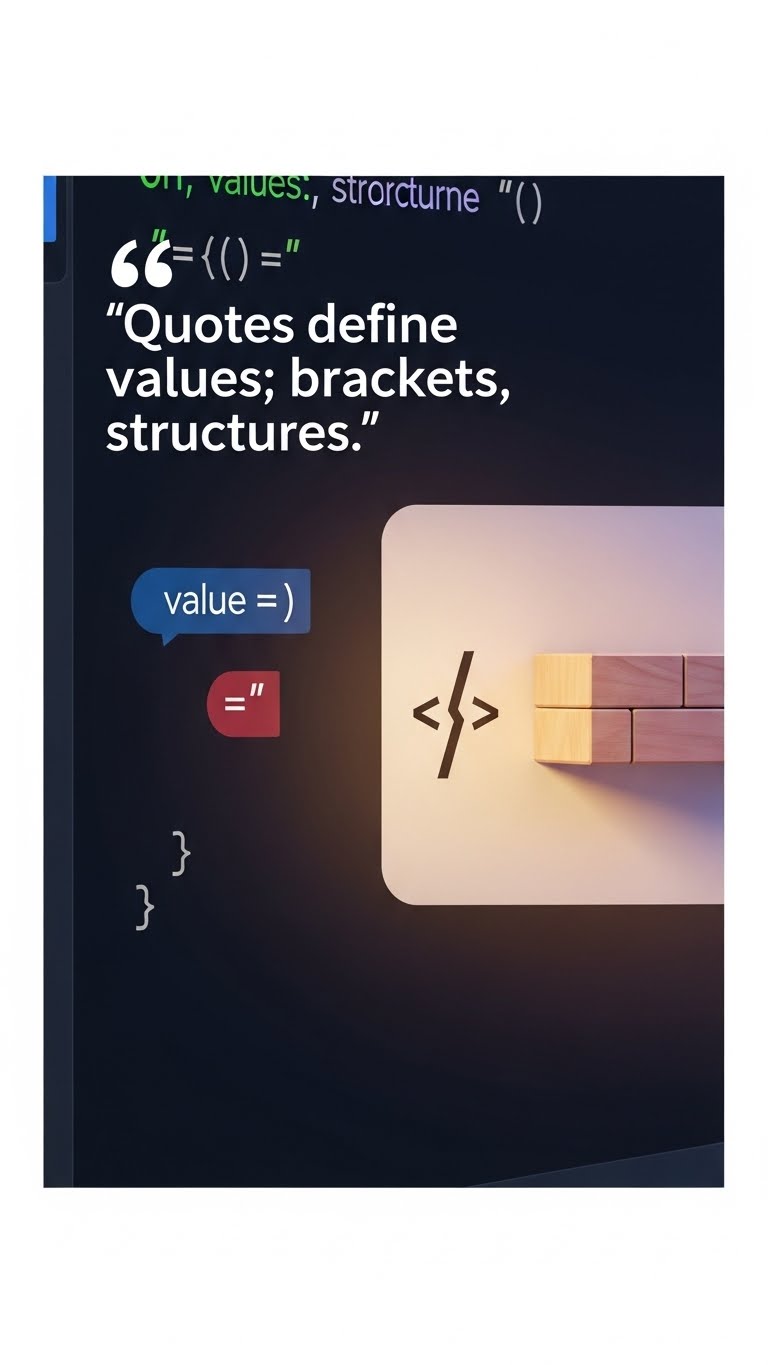
"The brackets give shape to the void; the quotes fill that shape with meaning."
Author: Digital Philosopher
Benefit: An abstract interpretation of structure and data flow.
"To confuse your delimiters is to speak a language where nouns and verbs are interchangeable—utter incoherence."
Author: Linguist of Code
Benefit: Compares syntax errors to fundamental linguistic confusion.
"Every developer learns the hard way: the compiler never guesses your intent; it only reads your syntax."
Author: Senior Developer
Benefit: A reminder about the unforgiving, rule-based nature of syntactic processors.
"Brackets handle instantiation; quotes handle specification. Separate tasks, separate tools."
Author: Object-Oriented Theorist
Benefit: Distinguishes the roles using terminology related to object creation and definition.
"The ability to distinguish between <A> and "A" is the first step toward coding maturity."
Author: Mentor Programmer
Benefit: Positions this knowledge as a foundational requirement for professional growth.
"Angled brackets define relationships between elements; quotes define the fixed state of data points."
Author: Database Designer
Benefit: Relates the difference to relational structure and static data points.
"A quote is a simple barrier; a bracket is a complex signaler, often requiring a corresponding closure."
Author: Markup Specialist
Benefit: Notes the difference in complexity, where brackets often require pairing and nesting.
"In generic programming, the angled bracket specifies type parameters, demanding rigorous adherence to template rules."
Author: Template Expert
Benefit: Highlights the use of brackets for type definition in languages like Java or C++.
"The quote tells the program what to say; the bracket tells the program how to say it."
Author: Communication Scientist
Benefit: Distinguishes content (quotes) from operational method (brackets).
"Without quotes, strings are vulnerable to interpretation error. Quotes grant immunity to special character processing."
Author: Security Analyst
Benefit: Points out the security and robustness benefit of using quotes correctly for input sanitization.
"The bracket is a command verb; the quote is a descriptive noun. They fulfill opposing parts of speech."
Author: Semantic Analyst
Benefit: Uses linguistic roles to define their syntactic function within code structure.
"One is structure, the other is content. Misalign the two, and the machine sees gibberish where you intended meaning."
Author: The Architect of Code
Benefit: Final reinforcing statement about the necessity of syntactic alignment.
Mastering the subtle yet profound difference between quotation marks and angled brackets is essential for crafting robust, readable code and markup. These symbols are the bedrock of modern programming syntax, and respecting their specific roles is the first step toward becoming a truly fluent digital communicator.
KEEP READING
40 Quotes: Unlocking the Meaning Behind the Words
Quotes are condensed wisdom. Dive into 40 profound sayings and uncover what these powerful words truly mean for success, motivation, and daily life, transforming simple words into actionable guidance.
Inspiration & LeadershipMaking History: 40 Quotes on Well Behaved Women
Explore the empowering meaning behind the phrase "well behaved women rarely make history" and discover 40 inspiring quotes about courage, leadership, and breaking barriers for profound impact.